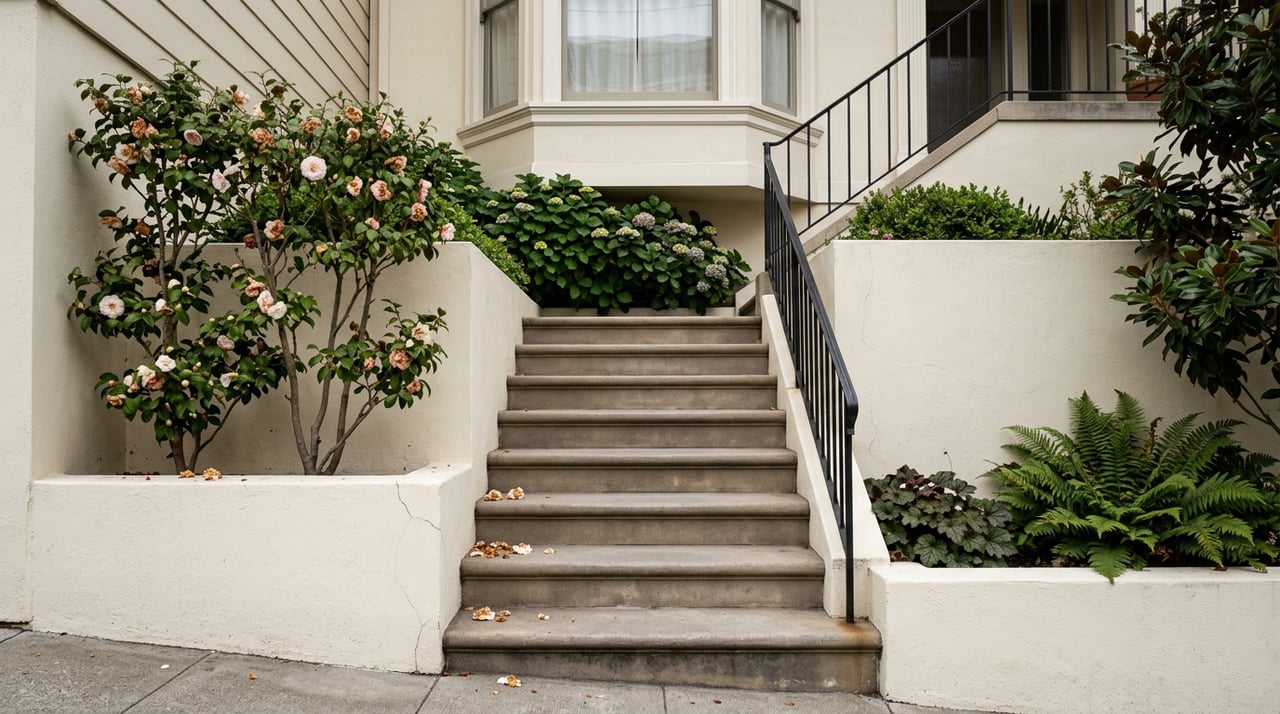
Walk to the corner of Turk and Parker some evening around six, when the fog is still deciding whether to commit, and you will see the same thing you see most nights: someone in running shoes standing at the bottom of the garden stairway that climbs into the University of San Francisco's Lone Mountain campus, stretching a calf against the low stone wall before starting up. Locals call it the Spanish Steps, a nod to the ones in Rome, and it has marked the Turk Street entrance to this hill since the Spanish Gothic building at the top went up in the early 1930s. There is no restaurant row at the base of it. No boutique strip lit up behind it. Just steps, and people climbing them, which turns out to say more about how this neighborhood actually functions than any list of coffee shops could.
Most San Francisco neighborhoods get profiled by their commercial spine. Marina has Chestnut Street. Cow Hollow has Union. Lone Mountain has neither, not really. Its roughly 72 restaurants, bars, and coffee shops are scattered along Geary Boulevard and the edges of California Street, shared in a loose way with Laurel Heights and the Inner Richmond, and the neighborhood is walkable enough that residents can typically reach four of those spots inside a five minute walk. But nothing there functions as a gathering point the way a stairway, a public track, and a playground campaign do. If you want to understand where Lone Mountain's actual social life happens, you have to look at its infrastructure, not its storefronts.
The stairway that isn't just a stairway
The steps themselves are not the whole story. Keep climbing and you reach the Sacred Heart Garden, where a marble sculpture called Tides has sat since October 2019. It was carved by sculptor Yoko Kubrick, who grew up a few blocks away on Octavia Street in Japantown, and commissioned by the alumnae of the Class of 1968 to mark their 50th reunion, back when this campus was still San Francisco College for Women. The class raised $100,000 for the piece, which weighs close to 4,800 pounds, and their gift also funded the garden around it and a mosaic of the Sacred Heart by Tom Lucas, S.J., set into the front of the building above.
None of this is roped off or ticketed. It is a public rest stop halfway up a residential hill, which is exactly how the students who watched it get lifted into place by crane described it at the time.
"It's really nice to have a little rest area going up all these stairs to Lone Mountain."
That was a USF student's reaction the day the sculpture went in, and it holds up. The building itself carries its own layered history: it was built for the Religious of the Sacred Heart order, became Lone Mountain College in 1968, and was folded into USF's campus in 1978 in a deal the university has referred to as its own Louisiana Purchase. Somewhere inside is the Del Santo Reading Room, where campus lore places the ghost of a nun known as Sister Agnes, a story nobody can confirm and everybody still tells. You do not need to be enrolled at USF to walk any of this. You just need to live close enough to make it part of your evening.
The other kind of climbing: Rossi Playground's own campaign
An easy walk from those steps, at Arguello and Anza, sits Rossi Playground and its pool, and this summer it became the site of a much quieter kind of local effort. A volunteer group calling itself Friends of Rossi put together a proposal for the city's Community Opportunity Fund, the program that lets neighborhood groups pitch small capital improvements directly. Their wish list was specific and unglamorous in the best way:
- Picnic tables outside the fenced playground and ball court area
- A community bulletin board near the pool building
- Ball court upgrades, including replacement benches, nets, backboards, rims, and a barrier between the basketball and pickleball courts
- Replacement bleacher seating at the baseball and softball field
- A simple manual scoreboard for that same field
- Modest, timer-controlled lighting near the playground, designed for early evening visibility without disturbing neighboring homes
Notably absent from the list: a mural, which the group left out at the guidance of Recreation and Park staff managing the funding process. A decision on the proposal was expected around June of this year. Whether it landed exactly as pitched is the kind of thing you find out by walking past the bulletin board, not by reading a press release, but the process itself tells you something true about the neighborhood. Rossi isn't a park that gets improved by outside developers or ballot measures alone. It gets improved because a handful of residents wrote up a list, argued for lighting that respects the people who live across the street from it, and turned in a form.
Just over the ridge, borrowing a track
Golden Gate Park's eastern edge, and Kezar Stadium along with it, sits close enough to Lone Mountain that plenty of residents treat the stadium track as their own, even though it technically belongs to the whole city. The current stadium, sometimes called Little Kezar, went up in 1991 with seating for 10,000 and an eight lane all weather track ringing the field, fronted by a stucco archway and clusters of pink cast concrete columns at the Frederick Street entrance. On weekday afternoons it belongs to high school and middle school track meets, and Special Olympics athletes hold their own practices there on Saturday mornings. But when no permit is in force, the gates open to anyone who wants to run a few laps.
This past July, that same track hosted two evening races that pulled runners out of the surrounding hills after work. On July 15, Trials of Miles Racing ran its Track Night SF series under the lights, presented by Tracksmith with pacers grouped by goal time, in partnership with local shops Running Wylder and A Runner's Mind. Two weeks later, on July 29, the Maurten Mile returned to the same oval, a USATF certified event that opened its gates at 4:30 in the afternoon for a 5:30 first heat. Neither race required a car. Neither required anything beyond walking down the hill in running shoes, which is precisely the kind of low friction weeknight plan that a neighborhood without its own commercial center tends to produce instead.
What this adds up to
None of this is new construction or a headline restaurant opening. That's the point. Lone Mountain's identity was never built around a strip of businesses the way its neighbors were. It was built around a university hill with a public stairway on it, a modest city playground that residents fight for improvement to a few line items at a time, and a stadium track just past the neighborhood's own border that fills up with runners on specific July evenings and empties out again the rest of the year. The businesses that do exist here, places like The Pig & Whistle, Altamirano Restaurant & Bar, Laughing Monk Brewing, and Mel's Drive-In along Geary, matter to the people who live here, but they were never asked to carry the neighborhood's social weight the way a main street does elsewhere in the city. The infrastructure carries it instead.
If you already live on one of these blocks, none of this changes your Tuesday. But it explains why Lone Mountain reads differently than the neighborhoods around it once you've lived here a while. It is not a place organized around where you eat. It is a place organized around where you walk, where you show up to argue for a scoreboard, and where you run when the stadium lights come on.
For residents thinking further ahead, whether that means understanding what a specific block on this hill is actually worth or simply wanting a clearer read on how Lone Mountain compares to the neighborhoods pressing in around it, Michelle Harris Properties offers a Private Market Review built around the same kind of block by block detail this neighborhood runs on. No pressure to act on it. Just a clearer picture, from people who know which staircase you mean without asking.